For a long time, p0 had one superpower. You told it what to build, and it built it. Specs, tickets, code, QA, pull requests across all your repos. Give it a decision and it turned that decision into shipped software.
But the decision itself was all on you. There was no place in p0 to step back and figure out what comes next. What should we build this week? Which idea actually moves our goals? What was that thing we promised to get back to? p0 was brilliant at the how, and had nothing to say about the what.
This is the story of how that changed, and how p0 went from waiting for instructions to coming to you with a plan. Its name is Pogo, and it’s the product manager that now lives inside p0.
The problem nobody was solving
Here’s what we kept seeing with the teams using p0.
Small teams don’t have a product manager. Or they have one who is stretched across everything. So the roadmap lives in the founder’s head. Decisions get made in a hallway, in a Slack thread, in the shower. And none of that ever reaches the agents doing the work.
Meanwhile, the good ideas die quietly. Someone says “we should really fix onboarding” on a Tuesday, everyone agrees, and nobody remembers it on Friday when there’s finally time to build.
We wrote it down in one line in the spec, and it stuck with me:
p0 is good at turning a decision into shipped code. It does not help with the decision itself.
p0 was reactive. It waited, patiently and very capably, for you to tell it what to do. We wanted it to also be proactive: to come to you with a plan, an idea, a “hey, have you noticed this?”
Chapter one: a face before a voice
The funny part is that Pogo’s face existed before Pogo did.
In early October we redesigned p0’s front door, the page where every session starts. We gave it a new question, the one we wanted every team to start their day with: What are we building today? And we wanted something on that page that felt less like a tool and more like a teammate. Something alive, ready to work with you.
So we built a living mark. A core with five smaller shapes orbiting it, each at its own speed, melted together with an SVG “goo” filter so they move as one and never quite hold still.

It was never meant to just sit there and look nice. It reacts. It speeds up while you type, like it’s listening. It pulses when you hit Start Building. It leans toward your cursor when you get close.
Without quite planning it, we had given p0 a face that paid attention. It could listen. It just couldn’t talk back yet.
Chapter two: give it a voice
Eleven days later we sat down to solve the “what should we build?” problem, and the answer was already looking at us from the top of the screen.
The mark already felt alive. It already reacted to you. What if it actually knew things? What if it remembered what your company is, where it’s going, and what your team shipped last week, and used all of that to tell you what to do next?
So we gave it a voice, and a job: product manager.
It started out with a placeholder name, and the spec even had a shortlist: Pip, Juno, Plum, Mo, Ori, Gus, Sage. None of them stuck. Three days in, the name came from home instead. Pogo is my pug. That’s Pogo on the right.

The original Pogo, on the right. Same calm stare, fewer opinions about the roadmap.
Designing a sparring partner, not a yes-machine
We had one rule from the start: Pogo should have opinions. A PM that agrees with everything you say is just a very polite notepad. Pogo should push back when an idea doesn’t serve your goals, and tell you why.
The first thing we designed was how Pogo gets to know you. Most tools hand you a long form. Pogo reads your code and your standards first, drafts what it can, and only asks about the gaps. Mostly the things code can’t tell it: your goals, your direction, who you’re competing with.
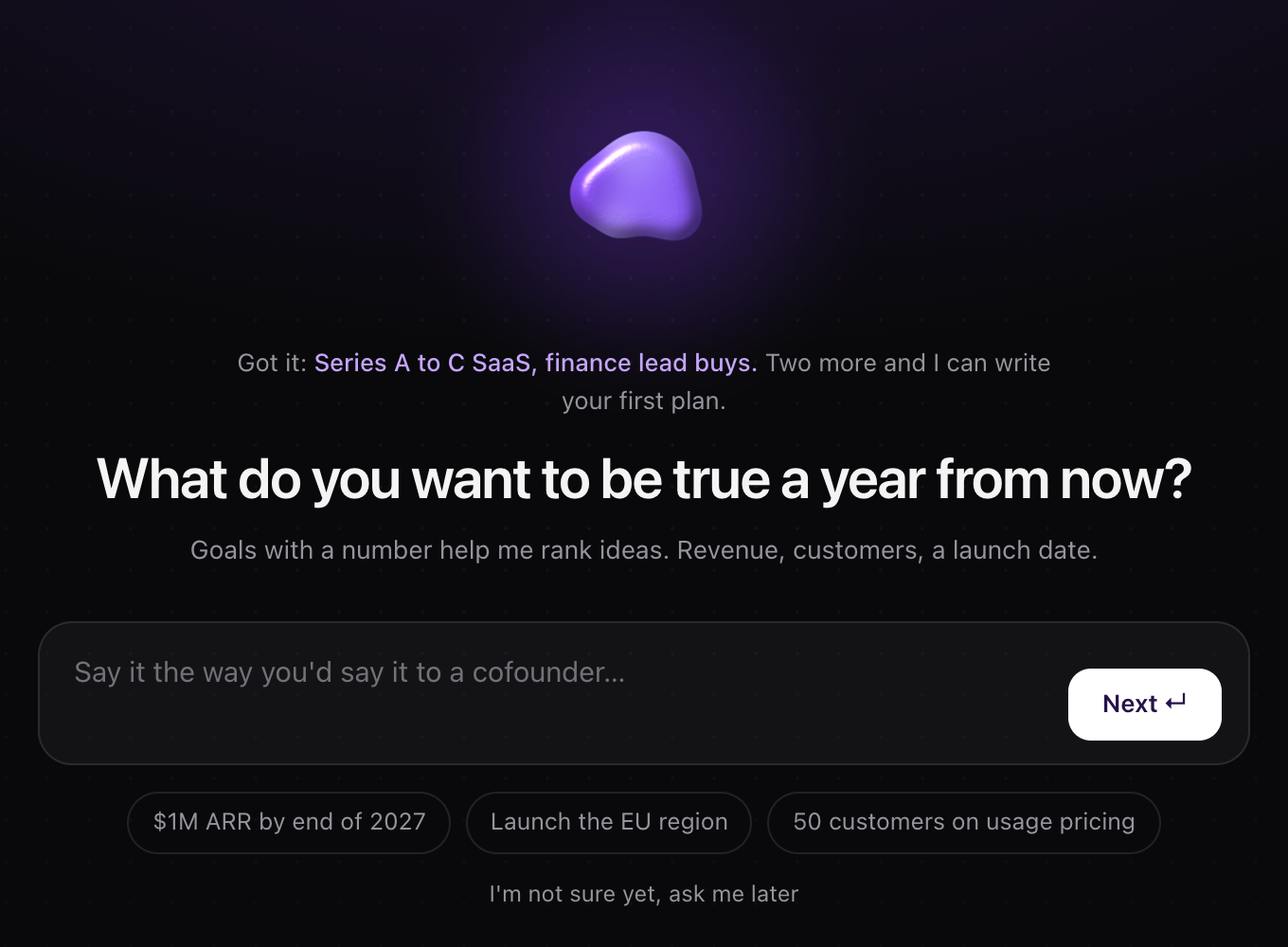
From an early mockup: Pogo has already read the code, so it only asks about what code can’t tell it.
Everything it learns goes into a shared product brain: product today, customers, goals, direction, competitors, constraints and decisions. One per workspace, the same for the whole team. Pogo can suggest changes to it, but a person always approves them.
Then we designed the conversation. Pogo is always one click away, and you talk to it like a teammate. Ask what to build next, ask it to poke holes in an idea, or ask it to size up a competitor. It searches the web and tells you what it found.
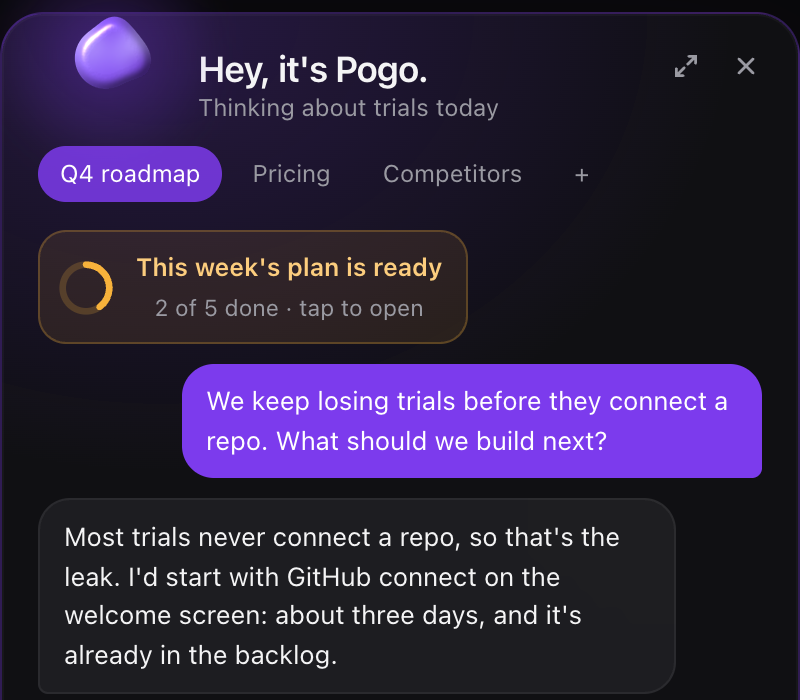
The companion, mid-conversation, from one of the mockups we picked from.
From reactive to proactive
This is the part I’m most excited about, because it changes what p0 is.
Before Pogo, nothing happened in p0 until you started it. Now:
- Every Monday, there’s a plan waiting. The first time someone on the team opens p0 on Monday, Pogo writes a short plan from the backlog, the ideas you saved and what shipped last week. Every item says why it matters this week. Check what you agree with and Pogo rewrites the rest.
- Ideas don’t die in threads anymore. Mention something in a chat and Pogo saves it to a backlog the whole team shares, sorts and plans from.
- It notices things. When there’s something new (the plan is ready, it saved an idea, a PR merged), the launcher shows a little badge. Merge a PR from the plan and Pogo offers to mark it done, and may suggest what comes next.
- Every agent knows the why. New sessions start with the product’s goals and this week’s focus, so the coding agents build toward the same picture you have.
- It knows what’s happening on GitHub. Pogo reads your open issues and recent pull requests, so its suggestions are grounded in what’s actually going on.
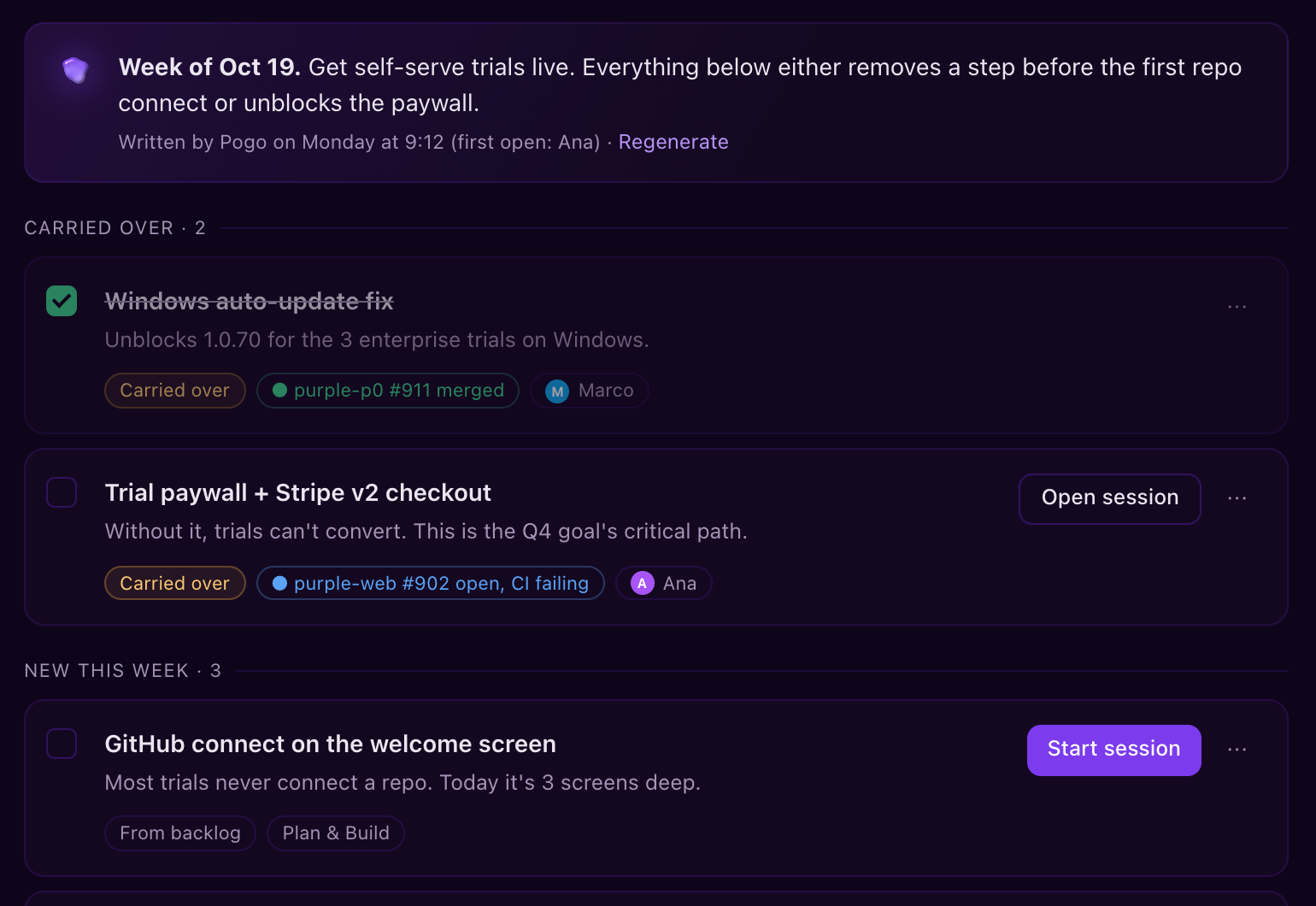
The “This week” page as we first sketched it. Pogo writes it, your team owns it.
And just as important is what Pogo doesn’t do. It never writes code. It never starts a session or sends a message on its own. Ask it to, and it will: start the session, reshuffle the week, answer the question a session is waiting on. Anything it sends is tagged “Sent by Pogo”. Proactive, not pushy. It also runs on your own Claude or Codex sign-in, like every other agent in p0.
Built with p0, obviously
Pogo was built the way we build everything now: in p0. A written spec, broken into 17 tickets across the desktop app and our API, implemented and QA’d by agents, reviewed by us. The face that started out listening on one page now has a voice, a brain, a backlog, a weekly plan and opinions. And p0 no longer just waits for you.
There’s something deeply satisfying about that loop. We used p0 to build the thing that helps p0 users decide what to build with p0.
Say hi
If you use p0, look for Pogo in the bottom-right corner. Hover it and you’ll see two doors: Chat and Product management. Start with the obvious question:
“What should we build next?”
Pogo will have an answer. It might even disagree with you.
— Andres